
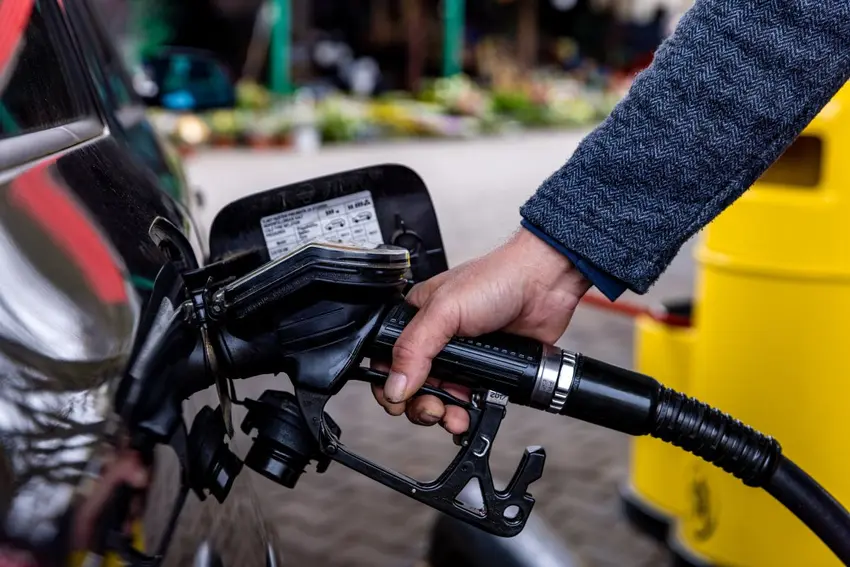
Germany's federal government announced on Monday two actions it has planned to help relieve drivers and companies amidst the oil price shock sparked by conflict in the Middle East.
In view of the high fuel prices, the black-red coalition of the Christian Union parties (CDU/CSU) and the Social Democrats (SPD), plans to relieve motorists with a significant cut on diesel and gasoline taxes, as well as enabling employers to pay tax- and duty-free relief bonuses to employees this year.
Chancellor Friedrich Merz said Germany will slash fuel taxes as households struggle with the energy price shock from the Middle East war. He also cautioned that the conflict will have long-lasting economic consequences.
The announcement came after oil prices surged again following the collapse of US-Iran peace talks and US President Donald Trump's decision to blockade the Strait of Hormuz.
Merz said the war "is the root cause of the problems we face in our own country", and stressed Berlin was doing all it could to try to bring the conflict to an end.
READ ALSO: How to save money on fuel in Germany as prices hit all time high
Tax cuts and relief bonuses
Following talks between his CDU party and its coalition partners, Merz said his government had decided to cut the tax on petrol and diesel by around 17 cents per litre for two months.
"This will very quickly improve the situation for drivers and businesses in the country, and above all for those who, mainly for professional reasons, spend a great deal of time on the road," he told a news conference in Berlin.
According to Labour Minister Bärbel Bas (SPD), the total value of the tax cuts is expected to amount to around €1.6 billion.
The federal government expects the oil industry to pass the tax relief on to consumers.
The relief measures quickly drew criticism however, with the DIW economic institute warning that much of the fuel tax cut may not be passed on to consumers.
"The package of measures shows a clear social imbalance," said DIW president Marcel Fratzscher, calling for "more targeted relief" for lower income households.

The coalition also plans to enable employers to pay a tax- and duty-free "relief bonus" (Entlastungsprämie) of €1,000 in 2026. Crucially, employers ultimately decide if they want to take advantage of the opportunity to pay their employees these tax-free bonuses.
The government suggests that the tax shortfall related to the above measures could be covered by an increase in tobacco taxes, to be brought in as soon as early as 2026.
Germany's leaders welcomed the European Commission's announcement that it would look into measures against the oil industry in line with the EU Energy Crisis Contribution 2022. In other words, an excess profit tax for oil companies at the EU level is on the table.
Fuel prices in Germany, like elsewhere, have jumped sharply since the outbreak of the US-Israeli war against Iran at the end of February.
Merz warned the war's effects were likely to be long-lasting: "The German economy will face a significant burden over an extended period."
Germany, Europe's biggest economy, has been hard hit by the surge in energy costs. Leading economic institutes this month slashed their growth forecast for Germany to just 0.6 percent for 2026, down from a pre-war prediction of 1.3 percent.
'State cannot offset all costs'
The federal government had so far been cautious in its reaction to intervening in the fuel cost crisis despite sky-rocketing prices in Germany and mounting fears of wider disruptions to related resources like jet fuel and fertilizer.
Up until Monday, the government had enacted just one new policy (from the start of April) that limited petrol stations from raising prices more than once in 24 hours -- a policy that seems to have failed to keep prices in check. The diesel price in Germany spiked to record highs shortly after the rule took effect.
READ ALSO: What's getting more expensive in Germany as fuel crisis deepens?
While announcing the planned fuel tax cuts, Merz cautioned that there is a limit to how much the state can afford to intervene: "We cannot offset every single outcome on the market with government funds...The state cannot absorb all uncertainties, not all risks, not all disruptions in global politics."
How quickly, and to what extent, the federal government should respond to the fuel crisis and related cost of living impacts has been a point of debate between various cabinet members from the leading CDU and SPD parties.
The chancellor stepped in to quell bickering between the Finance Minister Lars Klingbeil (SPD) and Economics Minister Katherina Reiche (CDU) over the weekend. The above mentioned tax cuts came as the result of a private meeting that the three leaders were involved in on Monday morning.
Criticism of the government's plans has come from opposition parties in the parliament including the Greens, the Left party and the Alternative for Germany.
Referring to recent experience, the Greens criticized the reduction in the energy tax as an ineffective way to support consumers. After Russia's attack on Ukraine in 2022, the traffic light coalition had brought a similar temporary reduction in fuel taxes.
"The fuel discount was an expensive gift to the oil companies -- not to the citizens," Green Party chairwoman Franziska Brantner told the dpa news agency.
Instead, she demanded a reduction in electricity tax for everyone, and called for revenues from the CO2 tax to flow back to the population. This idea has been proposed as various times in recent years, often called 'climate money' (Klimageld). It has so far failed to materialise in Germany, but was implemented in Austria.
READ ALSO: Taxes to health insurance - What reforms is Germany eyeing this spring?
With reporting by AFP and DPA.
Comments (1)